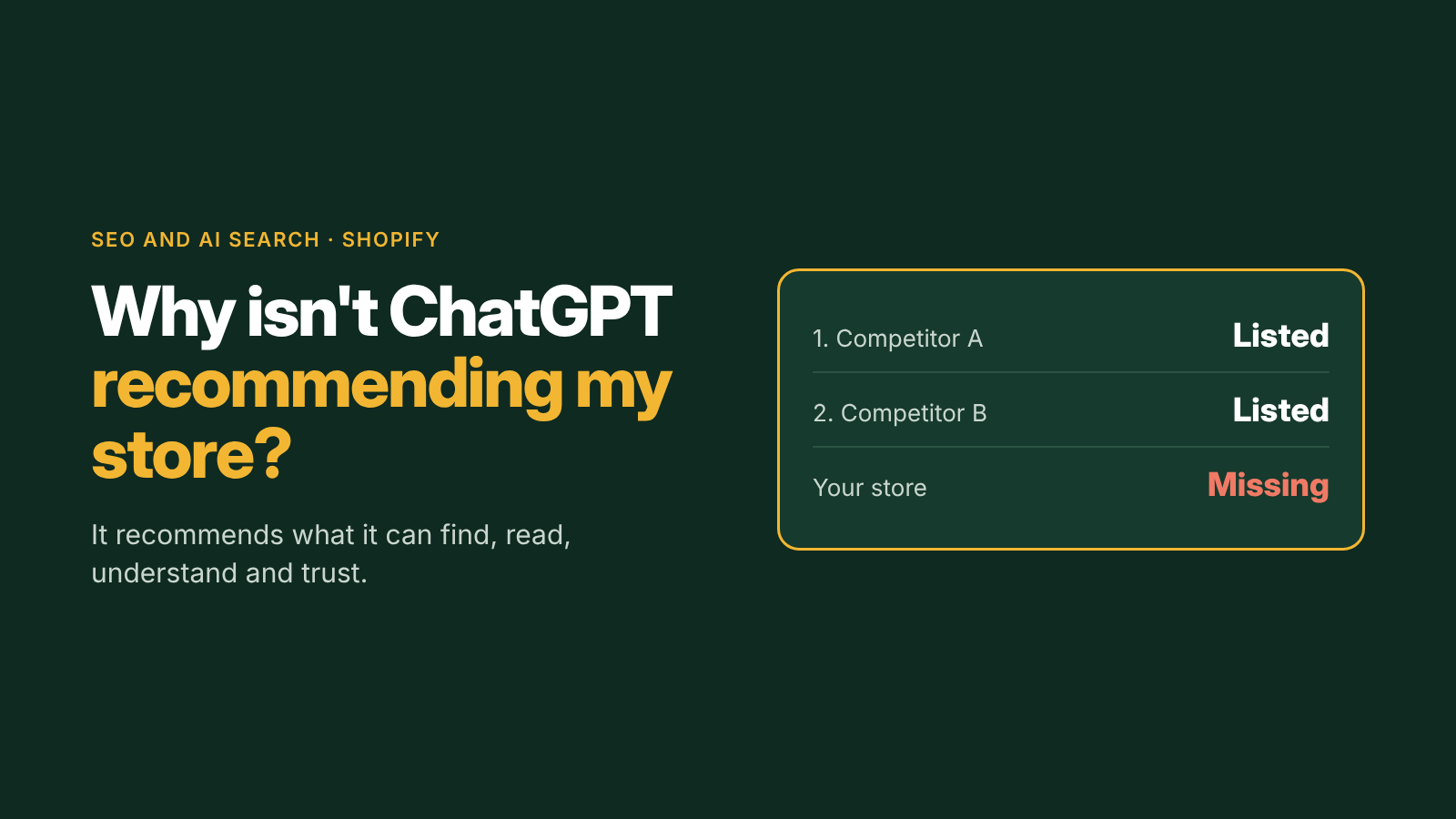
You ask ChatGPT for the best brand in your category and it lists three competitors. Not you. Customers are starting to shop this way, and it's frustrating when an assistant doesn't seem to know your store exists. The causes are usually more ordinary than people expect.
The short answer
ChatGPT recommends what it can find, read, understand and trust. Most Shopify stores that don't appear fail one of four tests: AI crawlers can't read the store, it isn't indexed well in the search engines assistants rely on, the pages don't say plainly what the brand sells and to whom, or there's too little proof and too few mentions elsewhere for an assistant to repeat. Fix them in that order.
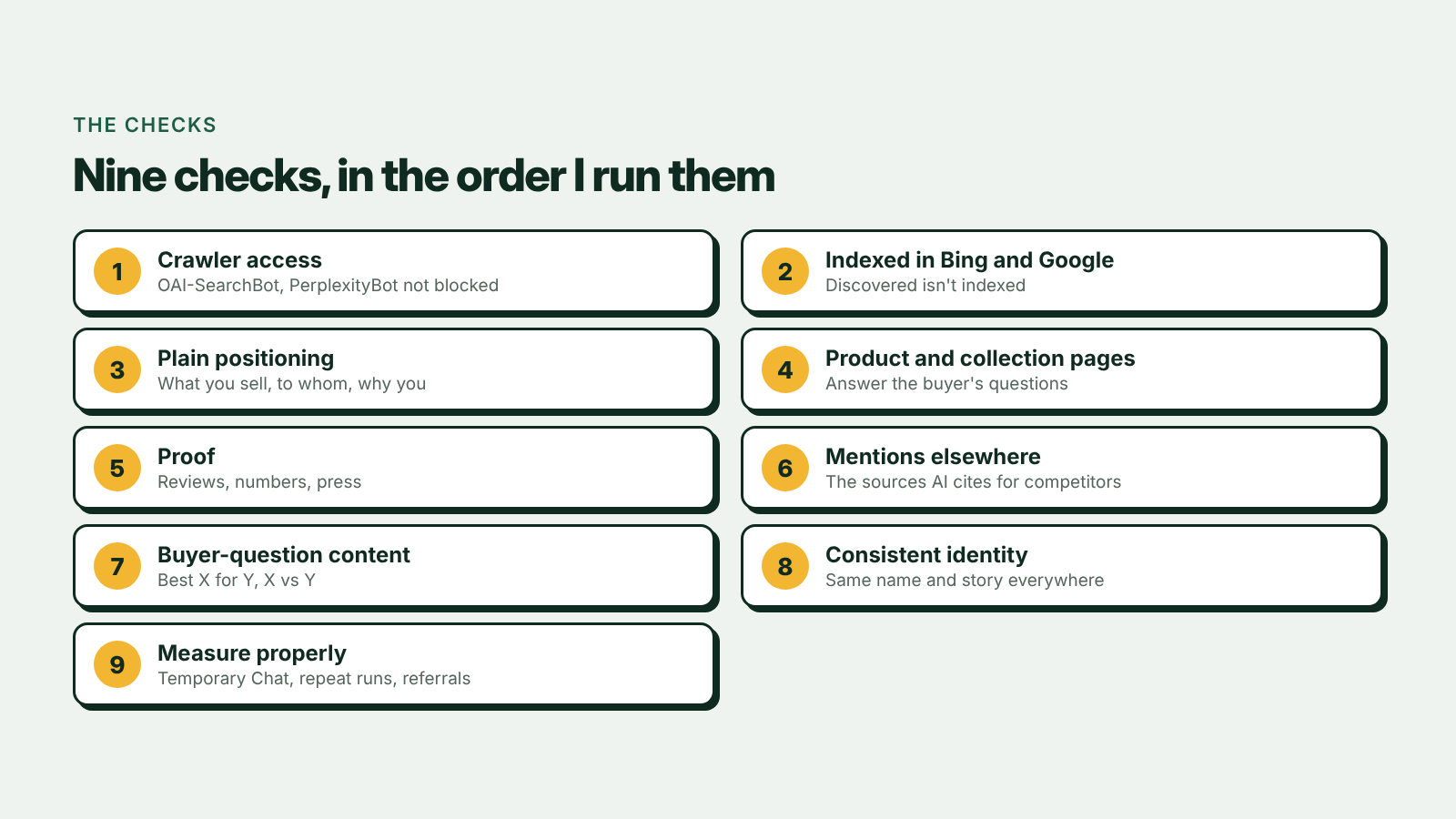
Nine checks, in the order I run them
1. Can AI crawlers read your store?
OpenAI uses separate crawlers for search and for training, and documents them in its overview of OpenAI crawlers; OAI-SearchBot is the one that matters for appearing in ChatGPT search. Check that your robots.txt doesn't block it or PerplexityBot, and that no bot-protection setting does either. On Shopify, robots.txt is controlled through the robots.txt.liquid template, which Shopify explains in editing robots.txt.liquid.
2. Is the store indexed in Bing and Google?
Most assistants search the web through engines like Bing and Google before they answer. If your collection and product pages aren't indexed, they can't be found. Check Google Search Console and Bing Webmaster Tools for pages that were discovered but never indexed.
3. Does your site say plainly what you sell, and to whom?
Assistants summarise. If your homepage says "elevated essentials for modern living", there's nothing to summarise. Use the words a buyer would type: what the product is, who it's for, what makes it different, and where you ship.
4. Do product and collection pages answer buyer questions?
Materials, sizing, who it suits, how it compares, shipping and returns. AI assistants quote pages that answer the question they were asked. Thin product pages with three lines of copy give them nothing to quote.
5. Is there proof an assistant can repeat?
Reviews on your product pages, specific numbers, awards, press and comparisons. An assistant is far more likely to recommend a product when it can say why.
6. Do other sites mention you?
Assistants trust what others say about a brand more than what the brand says about itself. Roundups, reviews, Reddit threads, YouTube reviews and press all count. If competitors appear in ChatGPT and you don't, look at which sources it cites for them; those are the places to earn a mention.
7. Do you have content for the questions buyers ask?
"Best X for Y", "X vs Y" and "is X worth it" questions are where recommendations happen. If a competitor has a clear, honest page answering one and you don't, that's often the whole difference.
8. Is your brand described the same way everywhere?
Use the same name, description and links on your site, Instagram, LinkedIn, marketplaces and directories, and link them to each other. Inconsistent descriptions make it harder for assistants to be confident they've found the right brand.
9. Are you measuring it properly?
Test in a Temporary Chat or logged out, because ChatGPT's memory favours brands you've discussed. Run each question several times, since answers vary. In your analytics, look for visits from chatgpt.com and perplexity.ai, which tells you whether being mentioned is turning into visits.
What about llms.txt and AI-only pages?
A short llms.txt summary and plain-text copies of key pages are cheap to add, and I use both on my own site. They help assistants read you; they don't replace the nine checks above. Never show AI crawlers content that visitors can't see. Search engines treat that as cloaking, and it can cost you your Google rankings.
My own site went from launch to a top ChatGPT recommendation in about two months using these checks. The full story is in How I Got My Site Recommended by ChatGPT in Two Months.
Want to know exactly why ChatGPT skips your store? The $500 Google and AI search visibility audit covers all nine, with a fix list in 3 business days. Or book a free call first.
Book a call
In 30 minutes I'll run your buyer questions through ChatGPT and Perplexity with you and tell you what I'd fix first. The ongoing version is the 90-day SEO and AEO program.