If you've launched a new ad account lately, you've probably seen this:
- CPMs stuck at $150 or more
- Weeks of "learning" that never ends
- Budget gone before the algorithm figures out who your customer is
It's not just us. Scroll Reddit or any ads community right now and you'll see the same complaint over and over: new ad accounts that can't escape high CPMs, no matter what creative they test.
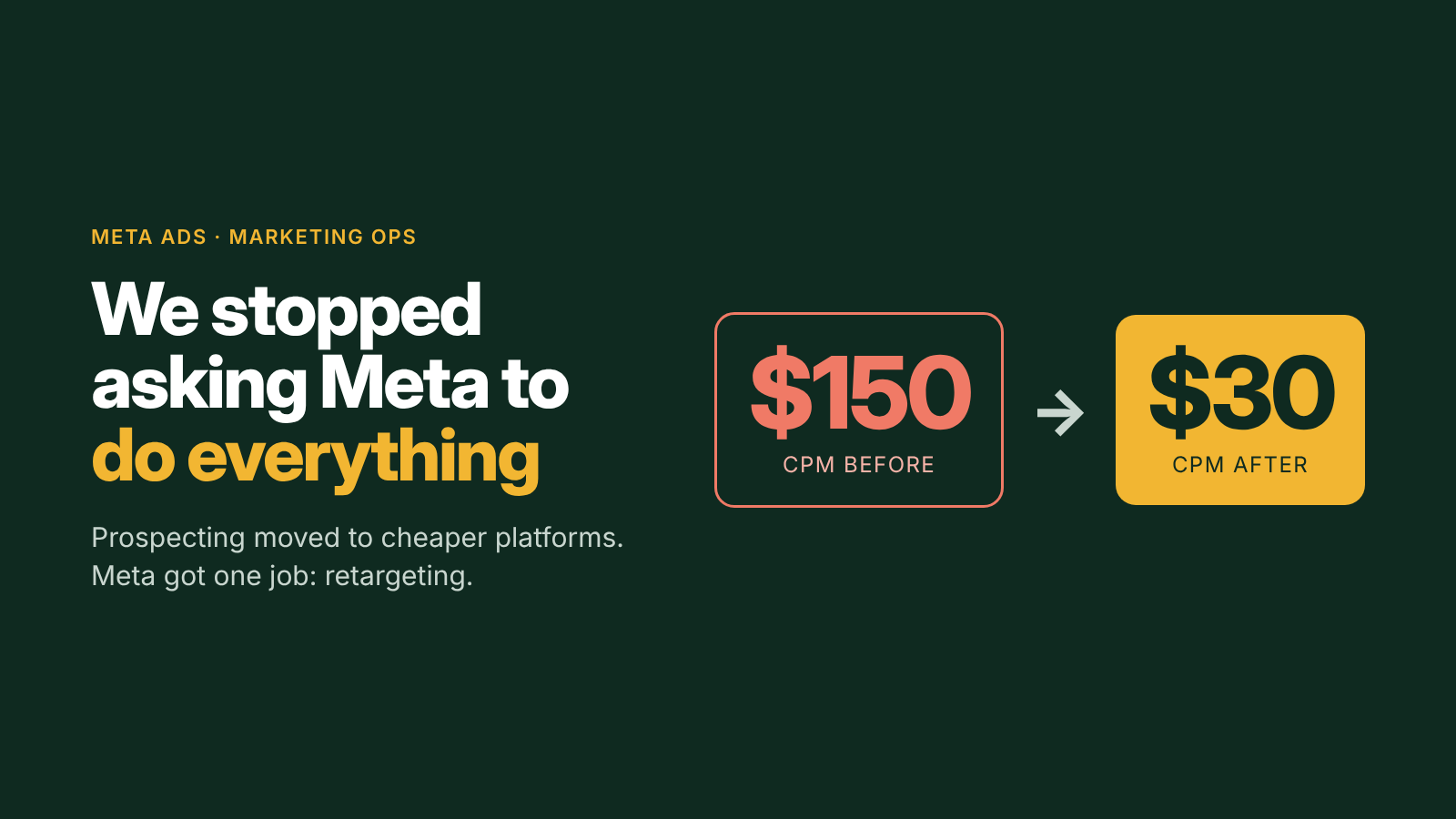
So we tried something different. Our Meta CPM went from $150 to $30. We didn't fix Meta. We stopped asking it to do everything.
The short answer
When a new Meta account can't find cold audiences at a reasonable price, stop paying Meta to do that job. Move prospecting to platforms where attention is still cheap, give Meta one job (retargeting people who already know you), and keep Google running to catch the searches that follow. The fix wasn't a new ad. It was a new structure.
Why new accounts get stuck at $150 CPM
A new ad account has no history. Meta doesn't yet know who buys from you, so it has to explore, and exploring broad cold audiences is the most expensive thing you can ask it to do. Add a thin budget spread across too many ad sets and the account never gets enough conversions to leave the learning phase. That's the loop: high CPM, slow learning, budget gone.
Before changing your structure, rule out the other usual causes. I go through six of them in Why Is Meta Ads CPM So High?, and if your account is spending without sales, how we got a supplement brand out of $200 CPM jail covers tracking and category restrictions, which can look exactly like this.
The structure we moved to
1. We moved prospecting off Meta
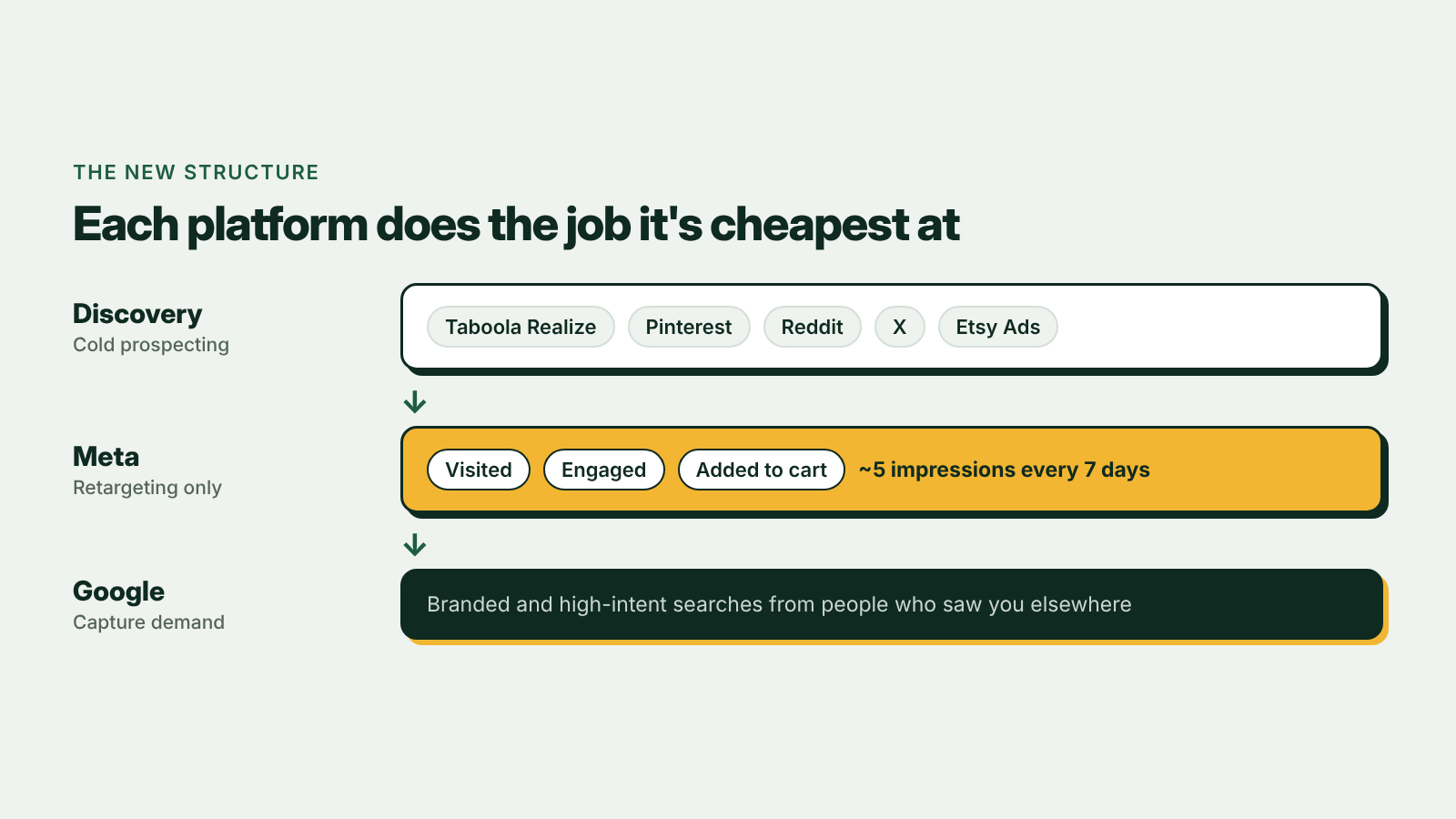
Instead of paying Meta $150 per thousand impressions to find cold audiences, we tested platforms where attention is still cheap:
- Taboola and its Realize performance platform
- X
- Etsy Ads, if you sell there
These platforms do the top-of-funnel work: getting your brand in front of new people at a fraction of the cost.
2. We made Meta do one job: retargeting
A strict retargeting campaign, only for people who already visited, engaged, or added to cart. We pushed frequency up to around 5 impressions every 7 days. Warm audiences need reminders, not introductions. Meta gives you direct frequency controls in some campaign types; Jon Loomer has a good explanation of how target frequency works.
Keep the retargeting audience clean: make sure your Pixel and Conversions API are reporting real visits and purchases, or Meta will retarget the wrong people. The Pixel and Conversions API audit page lists what to check.
3. Google stayed on to capture demand
When someone sees you on Pinterest or Reddit and then searches your brand, Google Ads is there to catch them. That's the branded search campaign in the Google Ads setup I use for Shopify.
The result
Meta CPM dropped from $150 to $30.
One honest caveat: retargeting a warm audience will always cost less per impression than prospecting a cold one, so Meta's CPM alone doesn't prove the whole funnel is healthier. Judge the change at store level: new customer acquisition cost and blended return across every platform, not each platform's own report. That's how I measure every account, and it's why budget follows results rather than any one platform's ROAS.
When this approach fits
- New or young ad accounts that can't get out of learning on Meta
- Products that are visual or searchable, which suit Pinterest and Google
- Niches with active communities, where Reddit and X audiences already talk about the problem you solve
It fits less well when Meta prospecting is already working at a cost you can afford. Then the job is to protect what's working, not rebuild it. Meta Ads Structure by Spend Level covers that side.
The lesson
Meta doesn't have to be your whole funnel. When it's expensive to find new people there, let cheaper platforms do the discovery and let Meta do what it's best at: converting people who already know you.
This is a marketing ops decision, not a creative one. The fix wasn't a new ad. It was a new structure.
Stuck with high CPMs on a new account? The $300 Meta ads and tracking audit tells you whether it's tracking, structure or the channel mix, with a written fix list in 3 business days. Or book a free call first.
Book a call
In a free 30-minute call, I'll look at your Meta account and your Shopify numbers and tell you whether a channel shift like this makes sense for your store. How I run accounts is on Meta ads for Shopify and paid ads for Shopify.